What is Persia Fabric? A Complete Guide to Its Features, Uses, Advantages, and Buying Tips
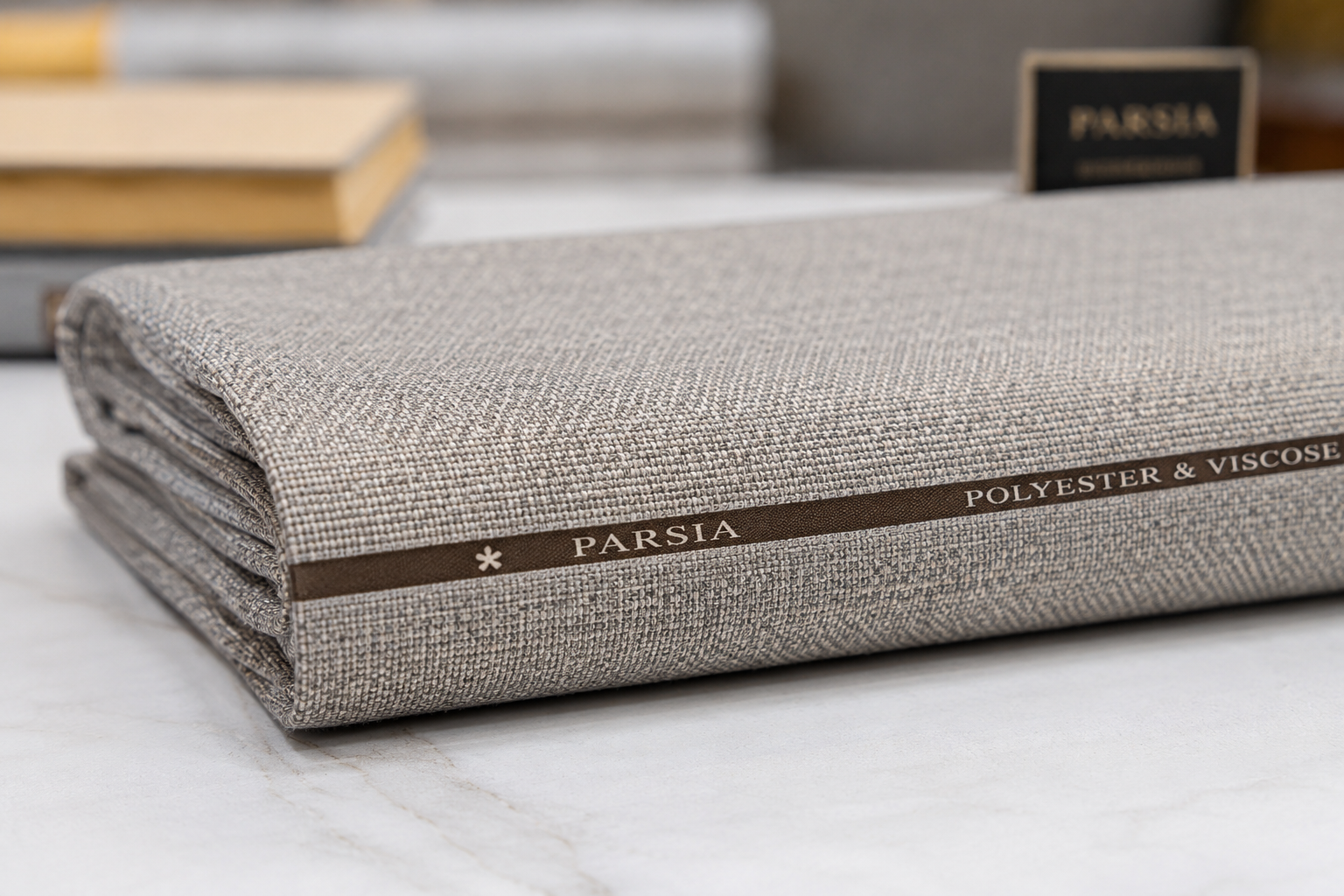
Persia fabric is one of the widely used textiles in Iran’s clothing industry, especially for producing uniforms, office manteaus, and organizational apparel. It is typically made from a blend of polyester and viscose fibers, which gives it a good balance of durability and appearance.
In the Iranian textile market, when the term “mechanical Persia fabric” is used, it refers to a specific type of weave produced using mechanized weaving machines, resulting in a uniform, consistent, and durable surface. This characteristic has made Persia fabric more popular than many of its counterparts in the production of organizational and corporate uniforms.
History and Introduction of Persia Fabric
Persia fabric was originally designed as an economical and practical textile to meet the needs of the formalwear and uniform clothing market. In recent decades, with the growth of the corporate apparel industry in Iran, the demand for fabrics with affordable prices, high durability, and a formal appearance has increased.
Persia fabric was developed in response to this demand and quickly established its place in the production of office manteaus, school uniforms, and workwear. Its main reason for popularity is the balanced combination of price and quality, which has led to relative satisfaction for both manufacturers and end consumers.
What fibers is Persia fabric made from?
The main structure of Persia fabric is usually composed of a blend of the following two fibers:
Polyester: for increasing durability, reducing wrinkle resistance, and extending the fabric’s lifespan
Viscose: for providing softness, better breathability, and a smoother feel against the skin
This blend makes Persia fabric neither as stiff as fully polyester fabrics nor as fragile as pure viscose fabrics. As a result, it creates a practical balance suitable for everyday use and organizational applications.
Production process of Persia fabric
The production of Persia fabric includes several main stages:
First, polyester and viscose fibers are blended in specific ratios. Then the produced yarns enter the mechanized weaving stage, which is usually carried out using a warp and weft weaving method.
In the next stage, the greige fabric enters the finishing process. This stage includes dimensional stabilization, surface texture improvement, dyeing, and anti-wrinkle treatments. The final quality of Persia fabric largely depends on this finishing stage.
Finally, the fabrics are classified based on weight (GSM), color, and quality, and then they are released to the market.
Key features of Persia fabric
Persia fabric has specific characteristics that make it suitable for office wear and uniforms:
Good resistance to abrasion and daily use
Less prone to wrinkling compared to cotton fabrics
Proper drape and structure on the body
Formal and uniform appearance
Wide variety of colors
Economical price compared to worsted fabrics
These features have made Persia fabric widely used in garments that require frequent and long-term use.
Advantages of Persia fabric
One of the main reasons for the popularity of Persia fabric is its practical advantages:
The first advantage is its affordable price, which makes it an economical option for mass production of uniforms. The second advantage is its high durability against frequent washing, which is very important for schools and organizations.
Additionally, due to its blended structure, this fabric is less prone to deformation and largely maintains its original appearance over time. The wide variety of colors also allows fashion designers to have more options in their selections.
Disadvantages of Persia fabric
Despite its advantages, Persia fabric is not without drawbacks:
Its breathability is lower compared to fully cotton fabrics
In some low-quality versions, there is a possibility of pilling
It may feel slightly warm in very hot conditions
Its quality varies significantly in the market and depends on the manufacturer
Therefore, choosing a reliable supplier is very important when purchasing this fabric.
Applications of Persia fabric in school uniforms
Also, thanks to its blended structure, this fabric is less prone to deformation and maintains its original appearance over time to a large extent. The high variety of colors also enables fashion designers to have more choices.
School uniforms need to be washed repeatedly throughout the academic year while still maintaining their appearance. Persia fabric meets this requirement to a reasonable extent, which is why it is widely used as a first choice in many garment manufacturing workshops.
Applications of Persia fabric in office and organizational manteaus
Persia fabric is one of the main options for producing office manteaus. Its proper structure and formal appearance make it highly suitable for workplace environments.
In organizational environments, clothing must look both professional and be comfortable. Persia fabric creates this balance, which is why it is widely used in companies, banks, and offices.
Applications of Persia fabric in trousers and formal wear
In addition to manteaus and uniforms, Persia fabric is also used in the production of formal and semi-formal trousers. Its good resistance to stretching and daily use makes it suitable for this application.
In some cases, this fabric is also used for budget-friendly suits, where the goal is to provide a formal appearance at a lower cost.
Difference between Persia fabric and Tergal fabric
Tergal and Persia fabrics both fall under the category of uniform fabrics, but they have some differences:
Tergal fabric is usually lighter and simpler, while Persia fabric has more structure and creates a more formal appearance.
Also, Persia fabric generally has a higher weave density, which results in greater durability compared to Tergal. For this reason, it is more preferred in office clothing.
Difference between Persia fabric and worsted fabric
Worsted fabric is considered a higher-quality and more expensive category of fabrics. It is usually made with natural fibers such as wool and has a much more formal appearance.
In contrast, Persia fabric is more economical and more suitable for everyday use and mass production. Therefore, if the goal is to reduce production costs, Persia is a more practical option, but for fully formal and luxury garments, worsted fabric would be the better choice.
How to identify high-quality Persia fabric?
To identify the quality of Persia fabric, you should pay attention to several factors:
Uniformity of the fabric surface
Absence of pilling or extra knots
Proper weave density
Color fastness against washing
Balanced softness without excessive stiffness
Low-quality fabrics usually lose their shape or fade after a few washes.
Factors affecting the price of Persia fabric
The price of Persia fabric depends on various factors:
The first factor is the quality of the fibers used in its production. The higher the quality of the viscose or polyester content, the higher the price.
The second factor is the dyeing method and the finishing process of the fabric. Fabrics with better finishing processes have higher durability and a higher price.
The third factor is the manufacturer’s brand and order volume. Generally, bulk purchases lead to a lower final price.
Wholesale buying guide for Persia fabric
When purchasing Persia fabric in bulk, it is essential to consider several factors:
First, you should clearly define your exact requirements in terms of weight (GSM), color, and intended use. Then, purchase from reliable suppliers to ensure product quality.
It is also better to check a fabric sample before making a bulk purchase to ensure that its quality meets your required standards.
Finally, comparing prices from several different manufacturers can help reduce the overall cost.
Conclusion
Persia fabric is one of the practical and economical fabrics in Iran’s textile industry, widely used especially in the production of school uniforms, office manteaus, and organizational clothing. With a blend of polyester and viscose, this fabric creates a balanced combination of durability, appearance, and cost.
Although it ranks lower compared to more luxurious fabrics such as worsted fabric, it is considered one of the best options in the market for mass production and everyday use.
If you have any experience using or purchasing Persia fabric, you can share your comments with us to help others make better decisions.